
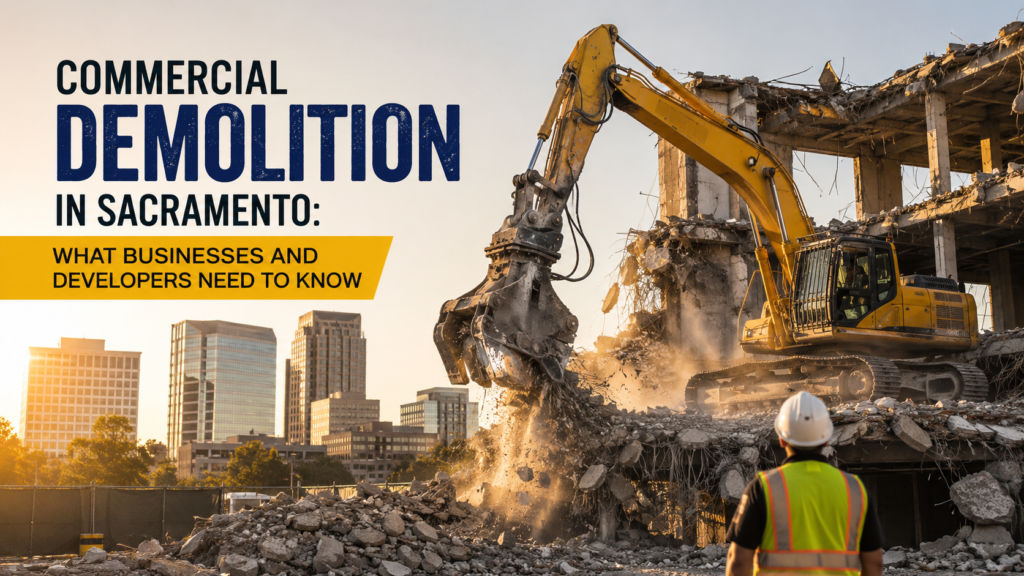
Sacramento’s commercial landscape is in active transition. The region’s sustained population growth, the ongoing revitalization of the downtown core, the redevelopment of former industrial corridors along the Sacramento and American Rivers, and the expansion of commercial activity in suburban communities across Sacramento, Placer, and El Dorado Counties all create consistent demand for Commercial Demolition Sacramento services. When older or functionally obsolete commercial buildings must be removed to make way for new development, or when commercial properties are being cleared for site repositioning, commercial demolition is the foundational first step. This guide explains what commercial demolition in Sacramento involves and how it differs from residential teardown.
What Makes Commercial Demolition Different from Residential Work
Scale is the most immediately apparent difference. Sacramento commercial buildings range from small neighborhood retail buildings of a few thousand square feet to large warehouse and distribution facilities, office campuses, and historic commercial structures in the downtown core. Larger structures require more powerful equipment high-reach excavators, larger material handlers, and greater hauling capacity and more complex demolition sequencing.
Structural systems in commercial buildings vary significantly from residential construction. Sacramento’s commercial building stock includes tilt-wall concrete construction (extremely common for warehouses and light industrial), pre-engineered metal buildings (prevalent for agricultural commercial and rural commercial uses), masonry bearing wall construction (typical of older downtown commercial buildings), and structural steel frame construction. Each of these requires different demolition approaches, equipment selections, and sequencing plans. Tilt-wall concrete panels, for example, must be carefully toppled in a planned sequence to avoid uncontrolled collapse and to manage the direction of fall and debris footprint.
Hazardous material profiles in commercial buildings reflect the building’s use history and age. Commercial buildings constructed before 1980 may contain asbestos in pipe insulation, boiler insulation, ceiling tile, floor tile, roofing, and joint compound. Buildings with industrial or process histories machine shops, dry cleaners, former gas stations, auto repair facilities may have soil and groundwater contamination from decades of operations that must be investigated before demolition can proceed. PCBs in older electrical transformers and capacitors, petroleum hydrocarbons in floor drains and sumps, and various process-specific chemical residues can all be present in Sacramento commercial demolition sites.
Regulatory Requirements for Commercial Demolition in Sacramento
Commercial demolition in Sacramento triggers multiple regulatory requirements beyond the basic building permit. The Sacramento Metropolitan Air Quality Management District (SMAQMD) regulates asbestos demolition notifications under Rule 902, which implements the EPA’s National Emission Standards for Hazardous Air Pollutants (NESHAP) for asbestos. Before demolition of any commercial structure that may contain asbestos, a licensed California asbestos inspector must survey the building. Regulated asbestos-containing material found must be removed and disposed of under SMAQMD notification and EPA NESHAP protocols before structural demolition begins.
Large commercial demolition projects in Sacramento may also trigger California Environmental Quality Act (CEQA) review, particularly for projects in historically significant areas, near sensitive habitat, or adjacent to regulated waterways. The Sacramento Regional County Sanitation District and the City of Sacramento’s stormwater program have requirements that apply when demolition activity could affect drainage or water quality.
Commercial demolition contracts in Sacramento often involve prevailing wage requirements when the project receives public funding, is on public property, or falls within the scope of California’s prevailing wage laws. Contractors performing commercial demolition on public projects must pay workers at the prevailing wage rates established by California’s Department of Industrial Relations.
Common Sacramento Commercial Demolition Project Types
Retail and restaurant demolition has been an active category across the Sacramento region as the retail landscape shifts, older strip centers and standalone retail buildings are cleared for redevelopment, and restaurant properties change hands with new operators wanting clean sites. Many of Sacramento’s suburban retail corridors along major arterials like Sunrise Boulevard, Watt Avenue, and Florin Road contain older buildings ripe for clearance.
Warehouse and industrial demolition serves Sacramento’s active industrial development market. The region’s position as a major distribution hub with access to Interstate 80, Interstate 5, and the Sacramento to Bay Area rail corridor drives demand for modern distribution and logistics facilities. Older, smaller industrial buildings are regularly cleared to make way for modern big-box distribution centers that meet current clearance height, dock door count, and truck court dimensions.
Office building demolition occurs periodically as aging office stock in Sacramento’s suburban office markets the Highway 50 corridor, the Natomas area, and suburban Roseville and Elk Grove is cleared for more competitive uses. Some older office buildings are beyond the economic point of renovation and are more efficiently cleared for new construction than rehabilitated.
The Commercial Demolition Process
Commercial demolition in Sacramento begins with a comprehensive pre-demolition survey documenting the building’s structural system, identifying all regulated materials, assessing environmental conditions, and mapping utility infrastructure. This survey is the foundation for the demolition plan, which sequences the work to manage safety, debris, and access throughout the project.
Mechanical demolition with excavators is the primary method for most Sacramento commercial demolition. Excavators in the 30-to-100-ton range handle the scale of most commercial structures. For multi-story buildings, high-reach excavators with extended booms work from the top down, breaking material and loading trucks without requiring crew to work at elevation. Material is sorted as it is generated metals for recycling, concrete for crushing, wood and general debris for disposal.
Commercial demolition in Sacramento generates significant volumes of recyclable material. Structural steel from metal buildings and reinforcing steel from concrete structures have scrap value that partially offsets demolition costs. Concrete is crushed into recycled concrete aggregate at Sacramento-area concrete recycling facilities. The Sacramento Valley’s active construction market provides consistent demand for these recycled materials.
Common Questions About Commercial Demolition in Sacramento
How long does commercial demolition take in Sacramento? Duration ranges from a few days for a small commercial building to several months for larger structures. Pre-demolition asbestos survey and abatement which must precede structural work often takes longer than the demolition itself for heavily contaminated buildings.
Is an environmental site assessment required before commercial demolition in Sacramento? Phase I and Phase II Environmental Site Assessments are often required or recommended for commercial properties with use histories that could have resulted in soil or groundwater contamination. Many commercial lenders and redevelopment entities require these assessments as a condition of financing or approving a project.
Can commercial demolition be done in phases in Sacramento? Yes. Large commercial demolition projects in Sacramento are frequently phased clearing one section of a building or campus while another section remains in use, allowing redevelopment to begin in cleared areas while demolition continues elsewhere. This phasing requires careful structural analysis to confirm that remaining portions of the structure are stable as adjacent sections are removed.